
‘The Long Walk’ May Be the Darkest Stephen King Adaptation Yet
At a Glance: Served by an excellent cast, The Long Walk is as bleak a Stephen King adaptation as they come, riddled with outbursts of violence and humanity – but deviating just a bit too far from the source material in the end.
I first read The Long Walk as a teenager roughly 20 years ago (God, I’m getting old), and since that first read I’ve been asking myself the same question: how in the hell has no one turned this into a movie? Well, two decades later and I finally had the pleasure to see the most depressing Stephen King novel I’ve ever read on the big screen.
After seeing King’s grim, dystopian nightmare in crystal clear Dolby Vision™, I kind of understand why it took so long for this adaptation to get produced. It’s dark, even by King’s standards, and in today’s political climate, it was honestly pretty uncomfortable watching you boys executed with rifles at point blank rage.
That’s the power of The Long Walk, though, and of King’s writing in general. The film is set in an America suffering from economic stagnation and fascistic oppression (sound familiar?), where every year 50 young men from across the states compete in a sadistic marathon for a chance to win whatever their hearts’ desire.
The rules are simple: keep walking at a minimum of 3 miles per hour. If you deep below the speed threshold, you’ll get a warning. After three warnings, you’ll be executed on the spot. Last boy standing wins.
The film largely consists of boys walking, talking, and dying… and not much else. That might sound like a bad thing, but The Long Walk manages to weave a tapestry of different emotions throughout its runtime, jumping seamlessly from playful humor, to nightmarish tension, to uplifting humanity, and everything in between.
The real drivers of this film are the cast of young men, who all feel like they were plucked directly from The Great Depression. They ooze with personality, and their odd, storybook banter creates a not-quite-real-life tone that helps to separate the audience from the brutality of their deaths. This is a kindness.
Leading the pack are David Jonsson (Alien: Romulus) and Cooper Hoffman (Licorice Pizza), two young men who become fast friends on their walk to oblivion. Their rapport is the heart of the movie, and it’s a genuine joy to watch them uplift each other through the darkest moments of the film. Their chemistry is fantastic, and one has to wonder if they were intentionally playing their relationship with some romantic undertones. Regardless, it worked.
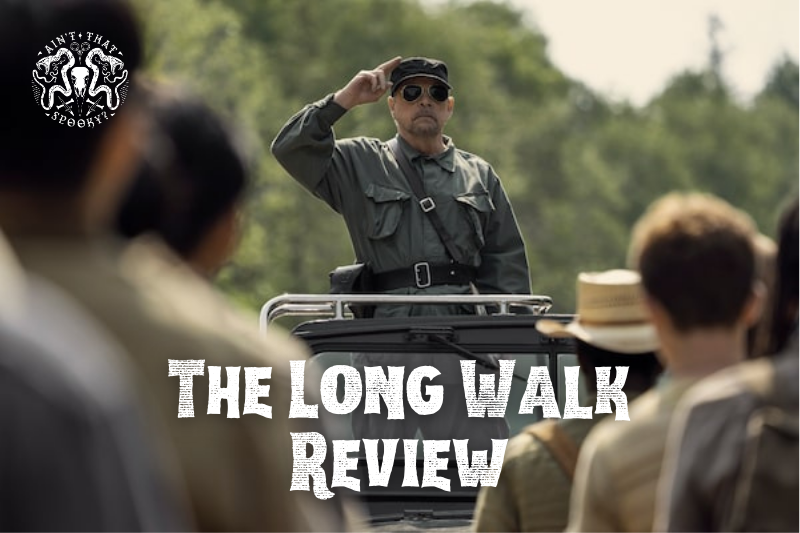
Rounding out the cast is the legendary Mark Hamill as The Major, the militaristic monster behind the gruesome competition. Speaking with a gruff affectation, he encapsulates the spirit of oppression and propaganda with his insincere patriotism and unrelenting bravado.
As any Stephen King fan will tell you, it always comes apart in the ending. I’m not a book purist by any means, I respect when adaptations do their own things and experiment with the material. In this case however, I feel like this is one of the rare occasions where the book ending is more impactful than the film’s. I’m going to leave it there, as I would like to avoid spoilers for those who haven’t seen it.
Overall, I felt like the film was a wonderful adaptation of King’s book, despite the change-up ending. It’s a tough watch for sure, so if depressing movies about kids being murdered isn’t your thing, I would advise against this one. However, if you can stomach it, this one is a powerful little film that doesn’t overstay its welcome.
 Ain't That Spooky
Leave a comment